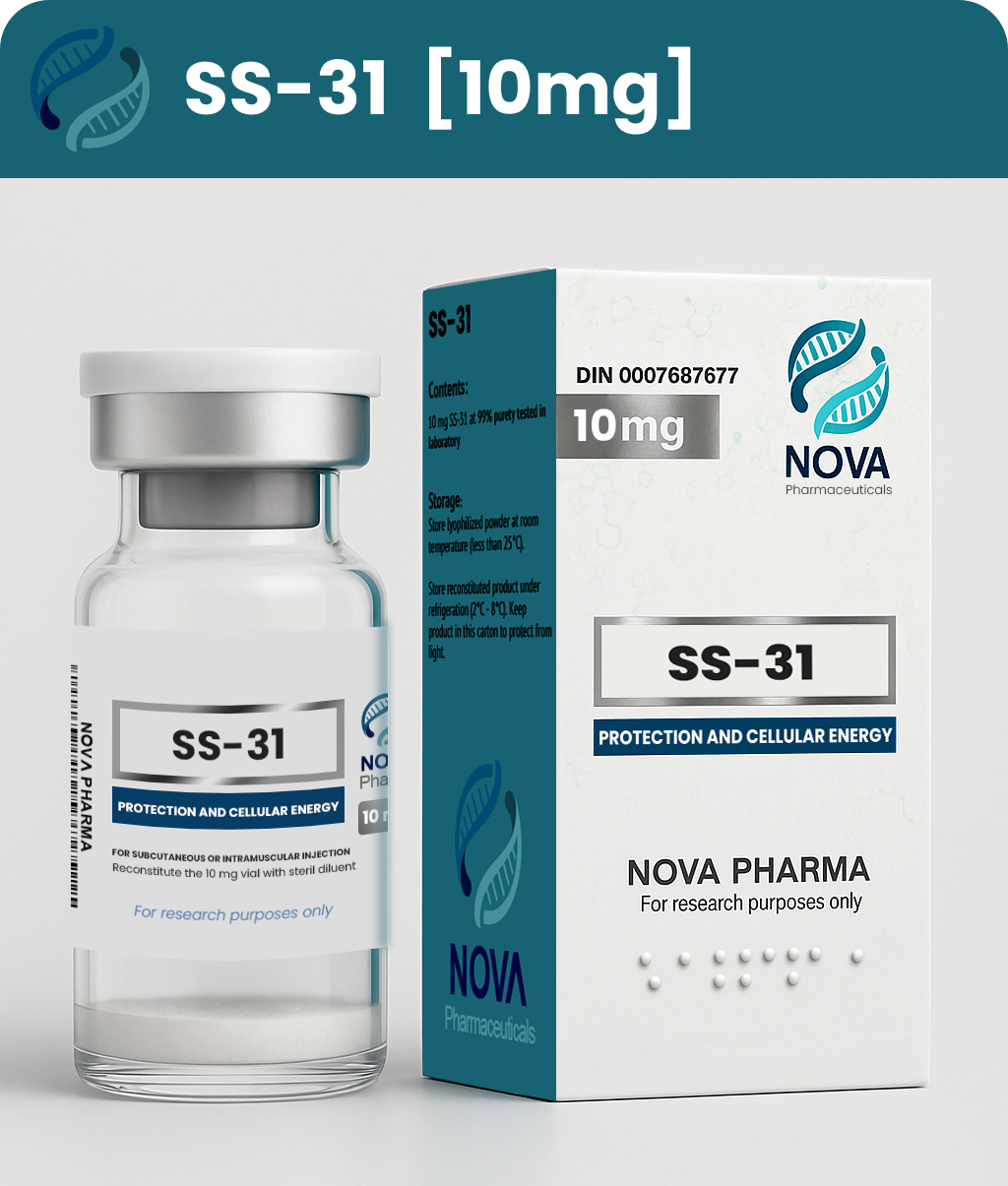
SS-31
Elamipretide — mitochondrial-targeted peptide. Protects and restores cellular energy production. Cutting-edge longevity compound.
Compound
At a glance
At a glance
- Concentration
- 25mg
- Purity
- 99.5%+
- Route
- Subcutaneous injection
- Storage
- Lyophilized: room temperature, desiccated. Reconstituted: 2–8°C, ≤30 days.
SS-31, also known as Elamipretide and by its pharmaceutical designation Bendavia, is a synthetic tetrapeptide (D-Arg-Dmt-Lys-Phe-NH2, where Dmt is 2',6'-dimethyltyrosine) that targets the inner mitochondrial membrane with remarkable specificity. It is one of the few compounds capable of penetrating the double-membrane structure of mitochondria and concentrating at the inner membrane — the site of the electron transport chain where 90% of cellular ATP is produced. SS-31 was developed at the Szeto-Schiller laboratory at Cornell University, and its mitochondrial-targeting properties have made it a leading compound in the emerging field of mitochondrial medicine.
SS-31 accumulates at the inner mitochondrial membrane through electrostatic interaction between its alternating aromatic-cationic motif and the anionic phospholipid cardiolipin. Cardiolipin is exclusively found in the inner mitochondrial membrane, where it plays an essential structural role in organizing the electron transport chain complexes into supercomplexes (respirasomes). Age, disease, and oxidative stress disrupt cardiolipin structure, fragmenting respirasomes and reducing electron transport efficiency while increasing reactive oxygen species (ROS) leak. SS-31 stabilizes cardiolipin-cytochrome c interactions, restores respirasome integrity, improves electron transport efficiency, and reduces mitochondrial ROS production — not by scavenging free radicals after they form, but by preventing their excessive generation at the source.
Research on SS-31 demonstrates improvements in mitochondrial ATP production, reduced oxidative stress markers, restored cellular bioenergetics in aged tissues, and protection against ischemia-reperfusion injury. Clinical trials have investigated its effects on heart failure (improved cardiac function and exercise capacity), age-related macular degeneration (improved visual function), renal ischemia (organ protection), and primary mitochondrial myopathy. In preclinical aging research, SS-31 reversed age-related decline in skeletal muscle mitochondrial function, improved exercise capacity in aged animals, and restored cardiac diastolic function.
SS-31 is suited for researchers investigating mitochondrial function, cellular bioenergetics, aging-related decline, cardioprotection, and organ preservation. It is the most extensively studied mitochondria-targeted peptide and a cornerstone compound for longevity-focused research protocols.
Reconstitute the 25mg vial with 2.5ml bacteriostatic water (yielding 10mg/ml). Administer via subcutaneous injection, typically 0.5-5mg per day depending on the research objective. SS-31 has a plasma half-life of approximately 2-4 hours but its cardiolipin-binding effects persist longer at the mitochondrial level. Daily dosing is standard. Store at 2-8C after reconstitution. The 25mg vial provides substantial supply for extended longevity research protocols. Lyophilized powder is relatively stable at room temperature but should be refrigerated for optimal preservation.
SS-31 is supplied as a lyophilized (freeze-dried) powder and must be reconstituted with bacteriostatic water (BAC water) before use in a research setting.
- Clean the BAC water vial stopper and the peptide vial stopper with an alcohol swab. Allow to dry.
- Draw the required volume of BAC water into a sterile syringe (typically 1–3 mL depending on target concentration).
- Angle the needle so the water runs down the inside wall of the peptide vial. Avoid dispensing directly onto the powder.
- Do not shake. Gently swirl or roll until fully dissolved. Vigorous shaking can denature peptides.
- Refrigerate reconstituted solution at 2–8°C. Most reconstituted peptides are stable 14–30 days depending on compound.
Target concentration determines drawing volume. For dosing math, consult the dosing math guide.
Independent lab verification
Research disclaimer
For research and laboratory use only. Not for human or veterinary consumption. Novo Pharma sells to qualified researchers of legal age and ships to Canadian addresses only. See disclaimer and terms.
Read the research
Reference articles from the lab covering this compound.
best of
Best Peptides for Anti-Aging & Longevity 2026: The Science-Backed Ranking
The definitive ranking of anti-aging peptides for 2026. Epitalon, SS-31, GHK-Cu, NAD+, and CJC+Ipamorelin — ranked by mechanism of aging they address. Science-backed longevity stacks with cost breakdowns.
comparisons
SS-31 vs MOTS-c: Which Mitochondrial Peptide Is Right for You?
SS-31 vs MOTS-c: two mitochondrial peptides with different mechanisms. Compare elamipretide (cardiolipin repair) vs MOTS-c (exercise mimetic) for longevity.
blog
Why Peptide Therapy Dominates Longevity Research in 2026
A survey of the 2024–2026 peptide longevity literature — what studies have moved the field, where the research is strongest, and what remains speculative.