MOTS-c
Mitochondrial-derived peptide. Enhances metabolic function, exercise capacity, and cellular energy production.
Compound
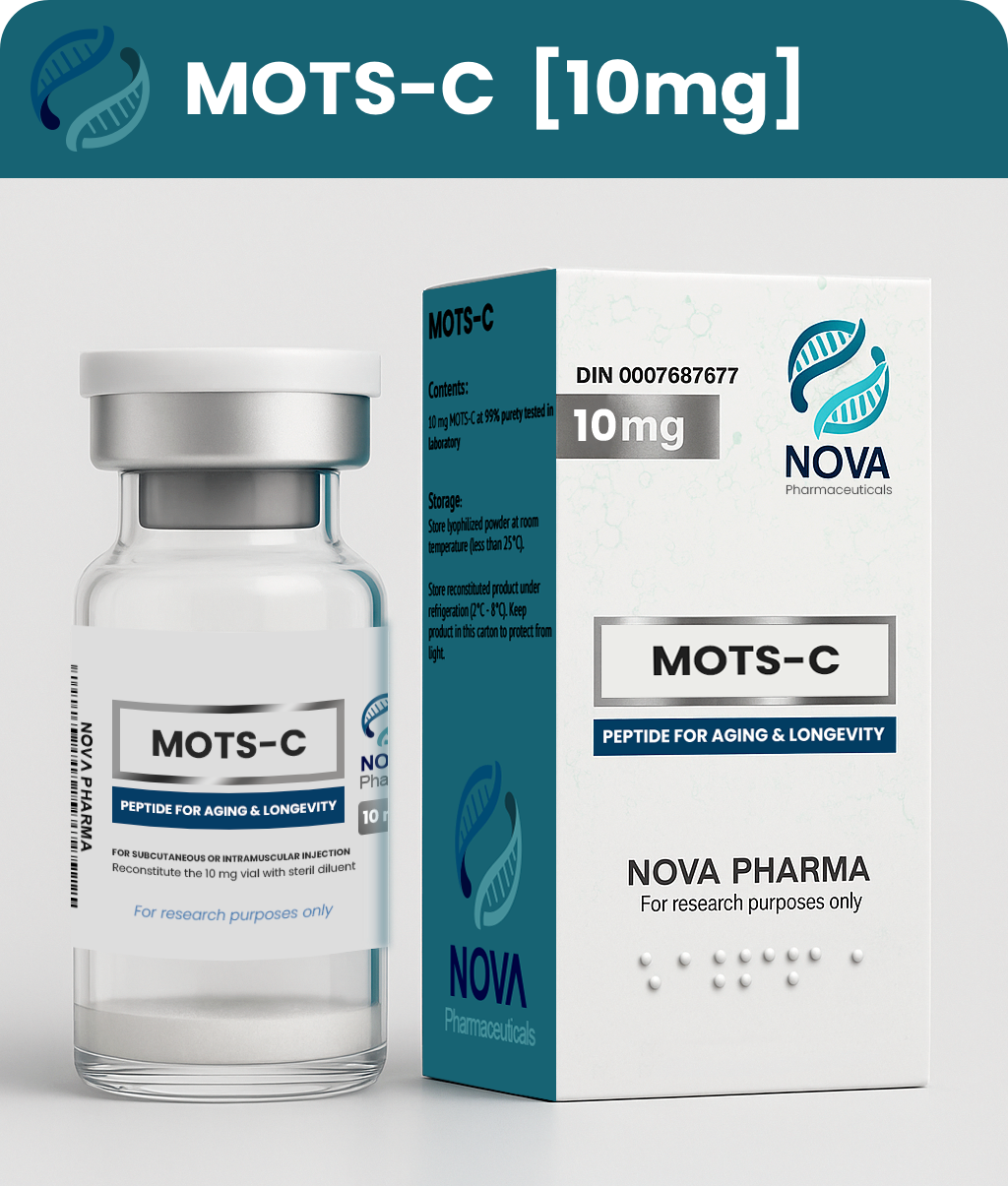
At a glance
At a glance
- Concentration
- 10mg
- Purity
- 99.5%+
- Route
- Subcutaneous injection
- Storage
- Lyophilized: room temperature, desiccated. Reconstituted: 2–8°C, ≤30 days.
MOTS-c (Mitochondrial Open Reading Frame of the Twelve S rRNA type-c) is a 16-amino-acid peptide encoded within the mitochondrial genome — specifically within the 12S rRNA gene. It was discovered in 2015 by Dr. Changhan David Lee at the University of Southern California, making it one of the most recently identified bioactive peptides in the longevity research space. MOTS-c belongs to a new class of signaling molecules called mitochondrial-derived peptides (MDPs), which challenge the traditional view of mitochondria as mere energy factories by revealing them as active endocrine organelles that communicate with the nucleus and distant tissues.
MOTS-c functions primarily through activation of the AMPK (AMP-activated protein kinase) pathway, the cell's master energy sensor. When MOTS-c activates AMPK, it triggers a cascade of metabolic adaptations: increased glucose uptake into skeletal muscle, enhanced fatty acid oxidation, improved insulin sensitivity, upregulated mitochondrial biogenesis, and activation of the folate-methionine cycle that regulates cellular methylation. Uniquely, MOTS-c has been shown to translocate to the nucleus under metabolic stress, where it directly regulates gene expression through interaction with antioxidant response elements (ARE). This nuclear translocation represents a novel mechanism: a mitochondrial-encoded peptide that can directly modify nuclear gene expression, establishing a mitochondria-to-nucleus signaling axis.
Research on MOTS-c demonstrates remarkable metabolic effects. Studies show prevention of age-related and high-fat-diet-induced insulin resistance, improved exercise capacity and physical performance, enhanced glucose metabolism, and resistance to metabolic stress. In aging models, MOTS-c administration improved physical performance and metabolic health markers to levels comparable to younger control subjects. The compound also shows exercise-mimetic properties — it activates many of the same metabolic pathways stimulated by physical exercise, leading some researchers to describe it as an "exercise pill" candidate.
MOTS-c is suited for researchers investigating metabolic optimization, exercise physiology, insulin sensitivity, mitochondrial signaling, and aging-related metabolic decline. It is particularly relevant for researchers studying the intersection of mitochondrial function and metabolic health.
Reconstitute the 10mg vial with 1-2ml bacteriostatic water. Administer via subcutaneous injection, typically 5-10mg per dose administered 3-5 times per week. MOTS-c has a half-life of approximately 4-6 hours. Research protocols typically run 4-12 weeks. Some researchers time administration pre-exercise to potentiate the metabolic response to training. Store at 2-8C after reconstitution. Lyophilized powder should be stored at -20C for long-term stability, as mitochondrial-derived peptides can be sensitive to degradation.
MOTS-c is supplied as a lyophilized (freeze-dried) powder and must be reconstituted with bacteriostatic water (BAC water) before use in a research setting.
- Clean the BAC water vial stopper and the peptide vial stopper with an alcohol swab. Allow to dry.
- Draw the required volume of BAC water into a sterile syringe (typically 1–3 mL depending on target concentration).
- Angle the needle so the water runs down the inside wall of the peptide vial. Avoid dispensing directly onto the powder.
- Do not shake. Gently swirl or roll until fully dissolved. Vigorous shaking can denature peptides.
- Refrigerate reconstituted solution at 2–8°C. Most reconstituted peptides are stable 14–30 days depending on compound.
Target concentration determines drawing volume. For dosing math, consult the dosing math guide.
Independent lab verification
Research disclaimer
For research and laboratory use only. Not for human or veterinary consumption. Novo Pharma sells to qualified researchers of legal age and ships to Canadian addresses only. See disclaimer and terms.
Read the research
Reference articles from the lab covering this compound.
comparisons
SS-31 vs MOTS-c: Which Mitochondrial Peptide Is Right for You?
SS-31 vs MOTS-c: two mitochondrial peptides with different mechanisms. Compare elamipretide (cardiolipin repair) vs MOTS-c (exercise mimetic) for longevity.
blog
Why Peptide Therapy Dominates Longevity Research in 2026
A survey of the 2024–2026 peptide longevity literature — what studies have moved the field, where the research is strongest, and what remains speculative.